On 24–25 January 2026, the Pro Game Jam took place in Tartu, within the framework of i-Game’s pilot activities.
More than one hundred participants joined the event organised by the University of Tartu Institute of Computer Science and the Estonian National Museum.
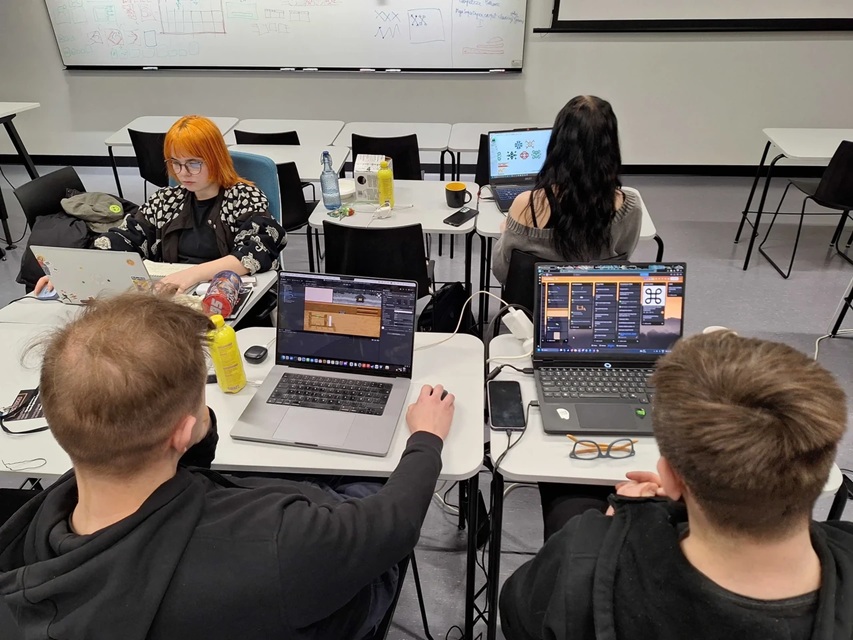
Their challenge was to develop a functioning computer game in just two days, drawing inspiration from traditional patterns. Before the work began, participants were introduced to the co-creation platform being developed within the i-Game research project, as well as the Estonian National Museum’s collections and textile patterns. After that, programmers, designers, mathematicians, and others dove into intensive work to assemble the most engaging game possible within 48 hours.
According to Pille Runnel, Research Director of the Estonian National Museum, the event demonstrated just how differently the theme of patterns can be interpreted
in games. “Over two days, we saw a wide range of solutions – from visually striking games to those where patterns were integrated into the game mechanics or narrative,” Runnel said. “This confirmed that cultural heritage in games does not need to be limited to decorative elements; it can form the core of the gameplay experience.”
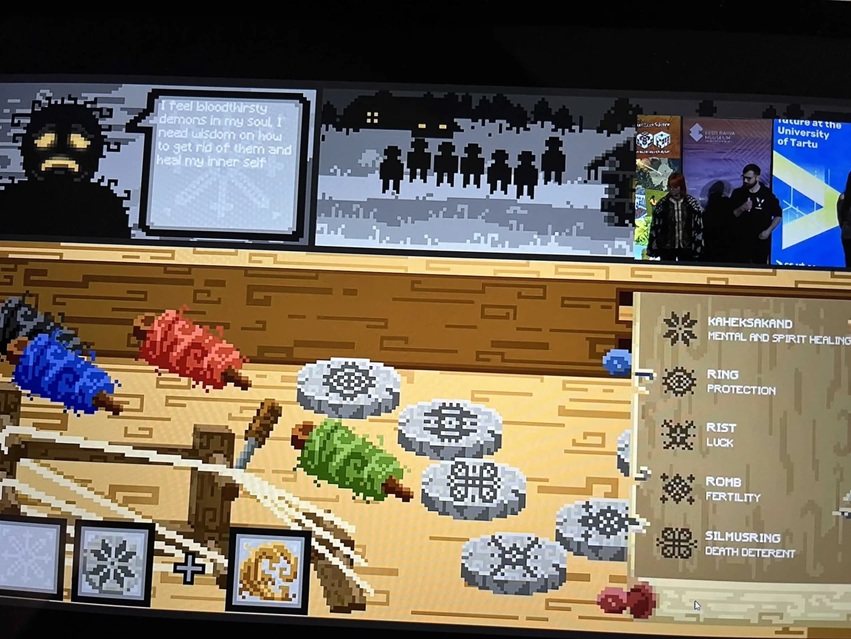
The participants’ favourite and the winner of the Estonian National Museum’s special prize was Patterns, Please, created by Aurelija Artsimovitsute, Ott Saar, Raigo Kovask, Liisa Leit, and Kevin Kelus. The game stands out for its coherence, humour, and thoughtful approach to Estonian national patterns and symbols. According to Pille Runnel, several of the games could already be used in a museum context to introduce national patterns and symbols. In the future, some of them will indeed find a place in the Estonian National Museum’s permanent exhibition Encounters.
Agnes Aljas, Research Secretary of the Estonian National Museum, emphasised that the contribution of the University of Tartu Institute of Computer Science was crucial to the success of the event. “The Game Jam showed that cross-disciplinary collaboration can produce solutions that are engaging for young people while also connecting meaningfully with cultural heritage,” Aljas noted. As the game co-creation research project continues, the Estonian National Museum plans to maintain its collaboration with the Institute of Computer Science.
Eventually, participants created 22 computer game prototypes over the course of two days. All games were inspired by digitised Estonian cultural heritage and are freely accessible online to anyone interested.
All created games can be played here: https://vote.aptgg.ee/event/utpgj26/teams
To play, click the “Jam” or “DL” button. Some games cannot be played directly in the browser.