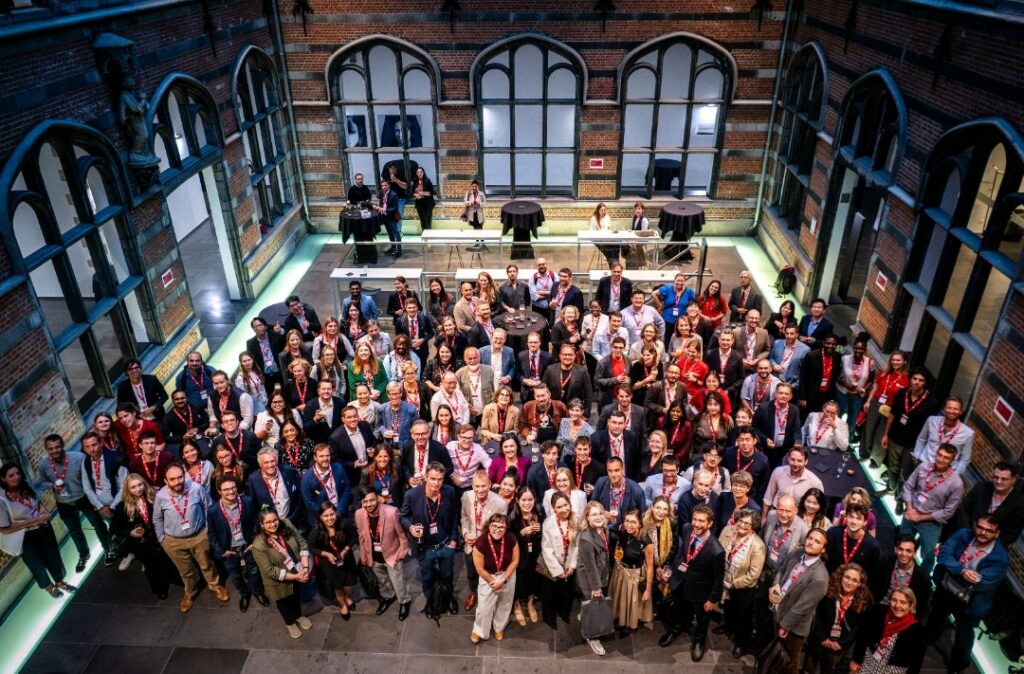
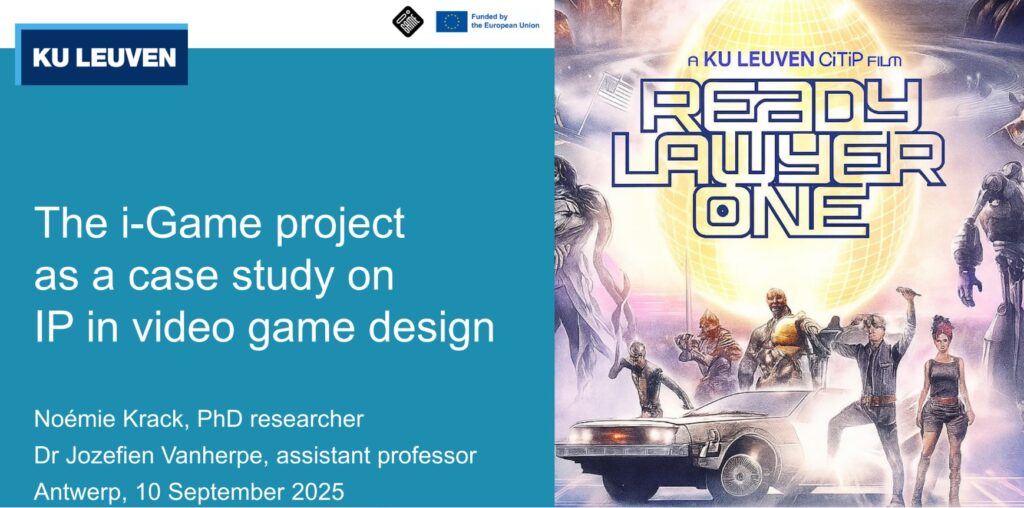
We were honored to participate in this year’s EPIP Conference “Turning IP Ambitions into Action: Creating Connections, Collaborations, and Communities”, where our partner in Belgium, KUL, presented the i-Game project.
More precisely, Dr. Jozefien Vanherpe representing KU Leuven Centre for IT & IP Law, discussed about the IP consideration in video game development and explored challenges in co-creation, aiming to raise awareness about IP complexity when it comes to video games and co-creation tools.
Within the framework of the EPIP Conference, an extended Abstract –‘Ready lawyer one’ the i-Game project as a case study on IP in video game design – was released highlighting an imbalanced IP protection in emerging models of co-development and co-ownership. Noémie Krack, PhD Researcher, and Editor-in-Chief of the European AI Media Observatory, and Dr. Jozefien Vanherpe, Assistant Professor at CiTiP, KU Leuven, dived into how resilient and adaptive IP frameworks that support fairness, transparency, and innovation can be developed in a video game co-creation context.
The first section of the paper examines the complex IP considerations in video games, which stem from their nature as complex digital products, the multitude of stakeholders involved across the value chain, the territorial nature of copyright, and the absence of video game-specific regulation, whereas the second section delves into IP issues related to co-creation, including the legal criteria for coownership, and assesses how these affect the video game industry and its collaboration with other CCIs, particularly in relation to IP management.
EPIP 2025 exceeded discussions on IP ambitions and focused on examining and recommending how these ambitions may be translated into action, in the context of the many global challenges facing our society (i.e., climate change, loss of biodiversity, inequality, pandemics, and geopolitical tensions). Surely, these challenges are also reshaping the IP landscape and underscore the need to think together about a more resilient and adaptive IP system. This year’s conference hosted about 150 papers in 35 parallel sessions, including 2 WIPO-sponsored sessions, 6 themed sessions and 2 book launches. On top of that, the three days of the conference brought together inspiring keynote speakers, scholars, policymakers, and practitioners committed to advancing knowledge on intellectual property and innovation.